Passion Fruit Cake with Mascarpone Icing
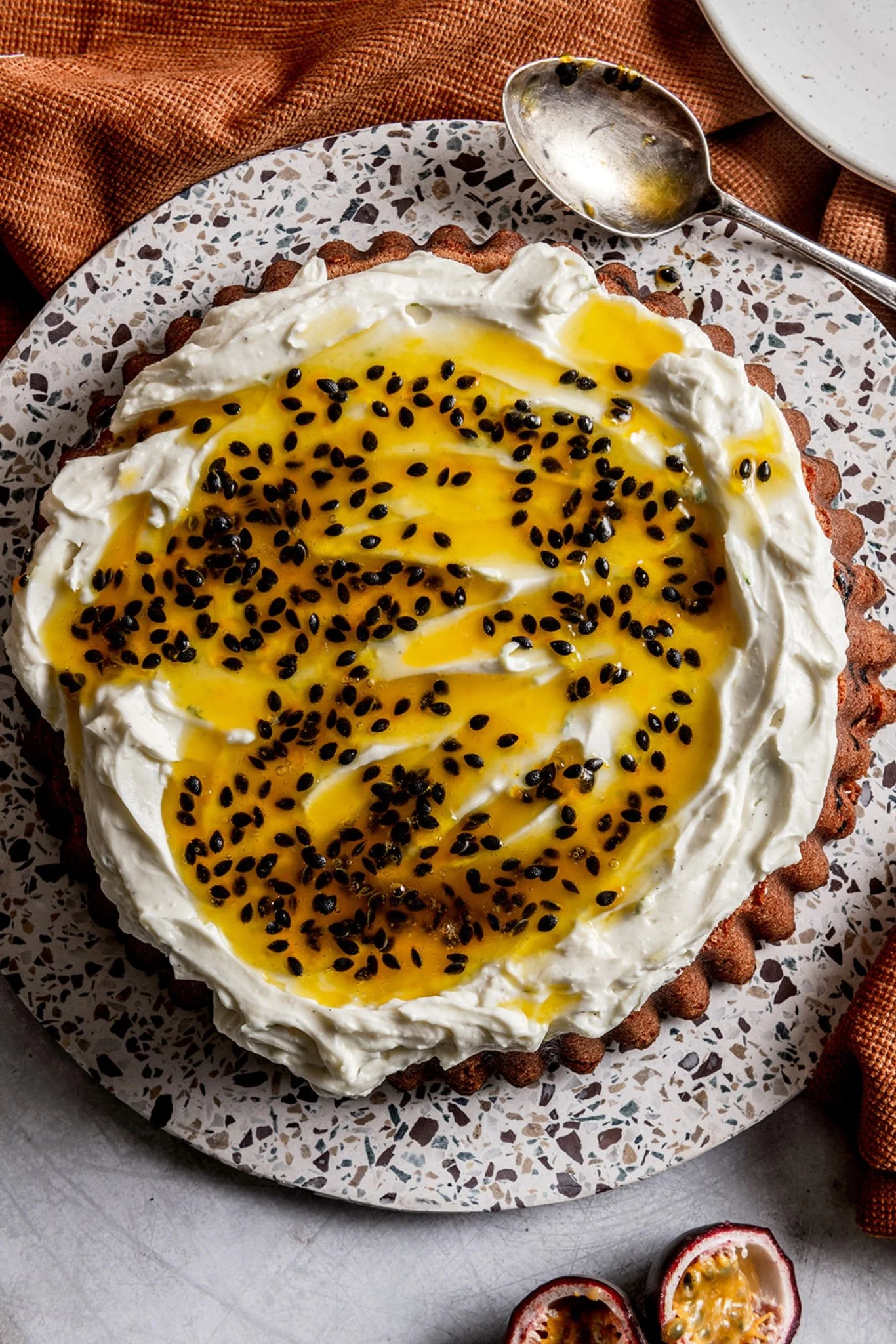
This passion fruit cake is a little different from the usual. It is baked in a fluted tart tin, which gives it a neat, elegant edge and a shape that looks far more involved than the bake actually is. The passion fruit pulp goes into the batter with the seeds left in, so you get a subtle crunch running through the sponge, much like poppy seeds. Ground almonds keep the crumb moist and slightly tender, and the zest of two limes lifts the whole thing, picking up the sharpness of the fruit.
The mascarpone icing is soft and creamy rather than firm, and the optional coulis adds a glossy finish and a concentrated hit of passion fruit. It works equally well as a light dessert or an afternoon cake with tea.

Passion Fruit Cake with Mascarpone Icing
A passion fruit and lime cake baked in a fluted tart tin, finished with a soft mascarpone icing and an optional passion fruit coulis. Ground almonds keep the crumb moist and the seeds add a gentle crunch through the sponge.
Ingredients
- 260g unsalted butter, softened
- 260g caster sugar
- 4 large eggs
- 300g self-raising flour
- 75g ground almonds (optional)
- 1 tsp baking powder
- 3 tbsp passion fruit pulp, seeds included
- Zest of 2 limes
- 2 tsp vanilla bean paste
- 3 tbsp milk (optional, if needed)
- 500g mascarpone, chilled
- 125g icing sugar, sifted
- 1 tbsp vanilla bean paste
- Zest of 1 lime (optional, to garnish)
- 5 passion fruit, pulp only
- 5 tbsp caster sugar
Instructions
- Preheat the oven to 180°C conventional or 160°C fan. Grease and line the base of the tin.
- Cream the butter and caster sugar in a large bowl until pale and fluffy.
- Beat in the eggs one at a time, making sure each is fully incorporated before adding the next.
- Fold in the self-raising flour, baking powder and ground almonds, if using, until just combined. Stir in the passion fruit pulp, vanilla paste and lime zest. Add the milk if the batter feels too stiff.
- Spoon into the prepared tin and smooth the top. Bake for 50 to 55 minutes, until a skewer inserted into the centre comes out clean.
- Cool in the tin for 15 minutes, then invert onto a serving plate and peel away the baking paper. Leave to cool completely.
- For the coulis, simmer the passion fruit pulp and caster sugar over a low heat for 3 to 4 minutes, until the sugar has fully dissolved. Set aside to cool.
- Whisk the mascarpone briefly to loosen. Sift in the icing sugar, add the vanilla paste and lime zest, and mix gently until just smooth. Stop as soon as it comes together to avoid splitting.
- Once the cake is completely cool, spoon or pipe the mascarpone icing over the top and spread to the edges.
- Drizzle with the cooled coulis just before serving. Serve chilled or at room temperature.
Nutrition Facts
Calories
655Fat
40 gSugar
40 gProtein
8 gCarbs
58 gApproximate values per serving


Ingredient Notes
Passion fruit
Passion fruit can be expensive, but the flavour is worth it. Look for fruit that feels heavy for its size with deeply wrinkled skin, which is the sign of a ripe one. Smooth fruit will be underripe and sharp. You will need ripe fruit for both the batter and the coulis.
Ground almonds
The ground almonds are listed as optional, but they do real work here, giving the sponge its moist, slightly crumbly texture. If you leave them out, the cake will be a little lighter and more open. See Variations for how to adjust if you do.
Mascarpone
Keep the mascarpone in the fridge until the moment you need it. Cold mascarpone holds together far better when whisked and is much less likely to split. Buy a good full-fat brand for the cleanest flavour.
Vanilla
Vanilla bean paste is used in both the sponge and the icing. It carries the flecks and depth that extract does not.
Kitchen Notes
Choosing and lining the tin
This is sized for a 24cm fluted, loose-bottomed tart tin, 5cm deep, which gives the cake its shallow, even crumb and neat fluted edge. Line the base with baking paper and grease the sides well so the fluting releases cleanly. If you are using a smaller, standard 23cm tart tin, which is shallower, reduce the batter by around a quarter so it does not overflow. In a deeper round cake tin the full quantity is fine, the cake will just bake a little taller. Adjust the timing as needed and trust the skewer test rather than the clock.
Do not overmix the icing
This is the step that catches people out. Whisk the mascarpone only until it is loosened, then fold in the sifted icing sugar and stop as soon as it is smooth. Pushed too far, mascarpone splits and turns grainy, and there is no bringing it back.
Cool the cake completely
The cake must be fully cold before the icing goes on, or the mascarpone will slacken and slide. Allow plenty of time, ideally an hour and a half, before you ice.
Testing for doneness
At 50 to 55 minutes a skewer should come out clean from the centre. Check at 40 minutes and if the top (remember thats going to be the bottom) is colouring too quickly before the middle is set, lay a loose piece of foil over it for the last ten minutes.
Making ahead
The cake itself keeps well before icing. Once iced, store it in the fridge and eat within three days. Add the coulis only when serving so it stays bright and does not bleed into the icing.
Variations
Seedless coulis
If you prefer a smooth coulis, strain the seeds out after simmering. Straining loses some of the pulp, so double the passion fruit to keep enough liquid, but do not double the sugar or it will turn too sweet.
Without the coulis
The cake is lovely with the mascarpone icing alone, or left plain as a simple afternoon cake. The coulis is a finishing touch rather than a necessity.
Lemon or orange
Swap the lime zest for lemon for a sharper note, or orange for something rounder and sweeter. Passion fruit takes well to all three.
Serving Suggestions
How to serve
Spread the mascarpone icing right to the edges and drizzle the coulis over just before the cake comes to the table, letting some run down the fluted sides. A little extra lime zest over the top finishes it.
Drinks
It is good with strong tea or coffee as an afternoon cake. As a dessert, a chilled glass of dessert wine or a passion fruit spritz works well.