Pulled Pork Buns with Fermented Rhubarb Barbecue Sauce
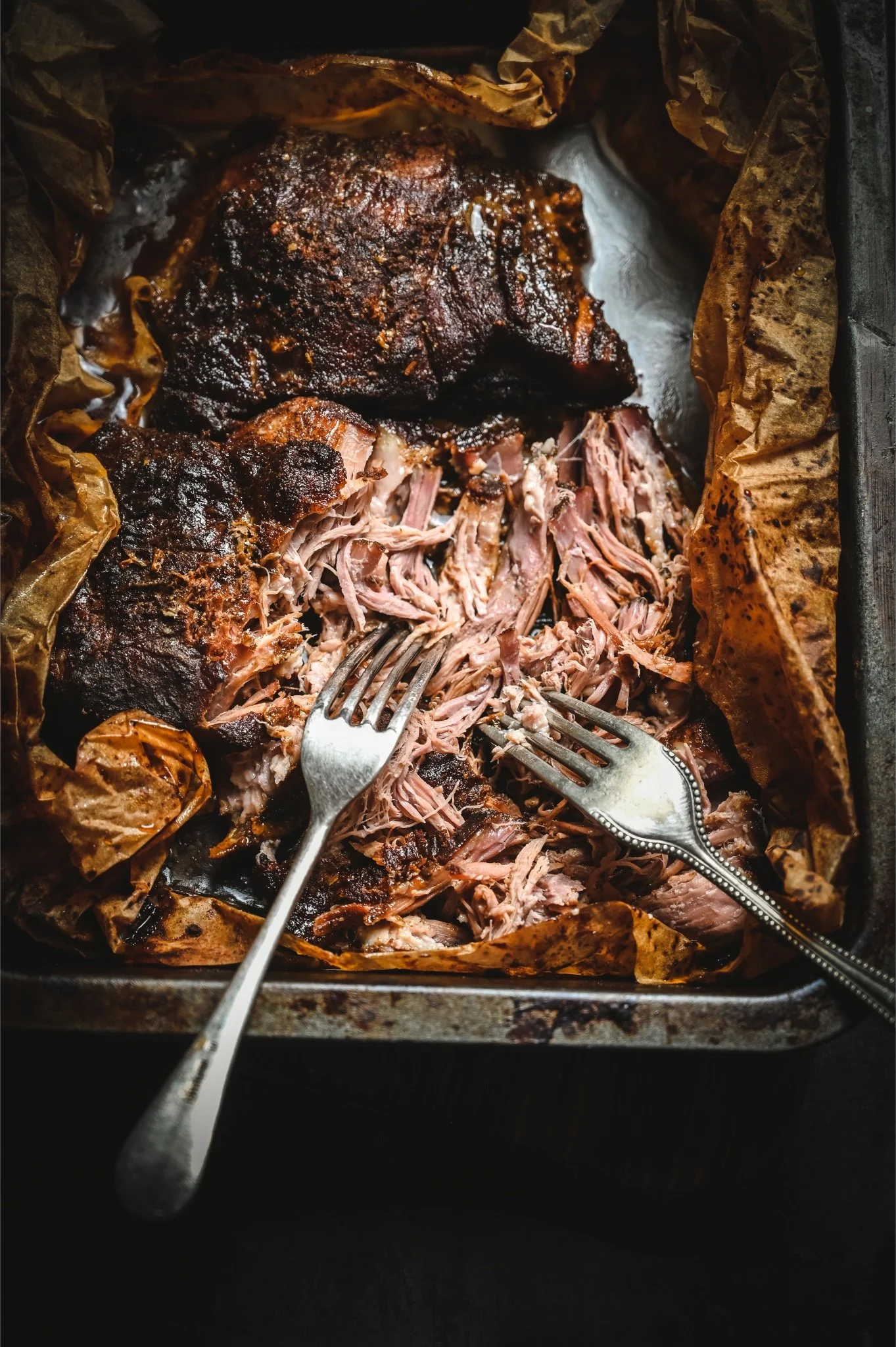
Pulled pork is one of those dishes that rewards patience generously. A pork shoulder, brined overnight, rubbed in a deep spice mix, and then slow-roasted in a sealed parchment parcel until it falls apart at the touch of two forks. The pork is good enough on its own. But it is the barbecue sauce that makes this recipe something to remember. Rich with ketchup, treacle, Worcestershire sauce, and orange juice, and then finished with fermented rhubarb, it has a tartness and depth that lifts the whole thing above the ordinary. Serve it piled into toasted brioche buns with red onion, herb salad, and pickles, and it is hard to improve on.

Pulled Pork Buns with Fermented Rhubarb Barbecue Sauce
Slow-roasted pulled pork shoulder, brined overnight, rubbed in warm spices, and served in toasted brioche buns with a homemade barbecue sauce finished with fermented rhubarb. A properly satisfying centrepiece.
Ingredients
- 1kg pork shoulder, boneless and skinless
- 1.5 litres water
- 80g non-iodised sea salt
- 75g dark brown muscovado sugar
- 1 tsp fennel seeds
- 2 sprigs of rosemary
- 1 red chilli
- 1 tsp cumin seeds
- 2 garlic cloves, lightly crushed
- 1 tsp mustard seeds
- 3 bay leaves
- 1 tsp whole black peppercorns
- 1/2 tsp garlic powder
- 2 tsp smoked paprika
- 1 tsp cinnamon
- 1/2 tsp cayenne pepper
- 1 tsp black peppercorns
- 1 tsp coriander seeds
- 2 tsp yellow mustard seeds
- 40g soft light brown sugar
- 1 tbsp rapeseed oil
- 2 tbsp runny honey
- 2 tbsp rapeseed oil
- 1 white onion, finely diced
- 250ml ketchup
- 70g brown sugar
- 30g black treacle
- 2 tbsp Worcestershire sauce
- 2 tbsp apple cider vinegar
- 180ml orange juice
- 2.5 tsp sweet smoked paprika
- 5 to 8 stalks fermented rhubarb, optional
- 8 brioche buns
- 2 red onions, cut into rings
- 100g herb salad
- 200g drained sliced burger pickles
Instructions
- Combine the salt and sugar with 500ml of the water in a saucepan. Bring to a gentle heat, stirring until both are fully dissolved. Remove from the heat, add the spices, herbs, garlic, and chilli, and allow to steep as the brine cools. Add the remaining 1 litre of cold water and refrigerate until completely cold before using. Place the pork in a deep container and pour over the cold brine. Weigh it down with a heavy oven dish or cast iron pan to keep it fully submerged, then cover and refrigerate overnight. If you have a large enough zip-lock bag to hold the pork and all the brine, this works well too. Seal it pushing out as much air as possible and lay it flat in the fridge. The next day, remove the pork from the brine, rinse under cold water, and pat dry thoroughly. Slice it in half across the widest part before applying the rub.
- Toast the whole spices for the rub in a dry frying pan over a medium heat until fragrant. Transfer to a mini blender with the remaining rub ingredients and blend to a paste, adding 2 tbsp of hot water to loosen.
- Massage the rub generously all over both pieces of pork. Leave to marinate for at least 30 minutes, or overnight in the fridge for best results.
- Preheat the oven to 160C. Line a deep roasting dish with two large sheets of baking parchment arranged crossways. Place the pork inside and wrap the parchment tightly around it, scrunching the edges to form a sealed parcel. Cover the dish with two layers of foil secured firmly around the edges. Roast for 4 hours.
- For the barbecue sauce, heat the rapeseed oil in a small saucepan over a medium heat. Add the onion and cook for 5 to 10 minutes, stirring regularly, until softened but not coloured. Add all remaining ingredients except the fermented rhubarb and cook for 10 minutes, then blend to a smooth sauce.
- Remove the pork from the oven. Unwrap the parcel carefully and shred the meat using two forks, discarding any large pieces of fat. Pour half the barbecue sauce over the shredded pork and mix well to combine. Rewrap and return to the oven to keep warm until ready to serve.
- If using fermented rhubarb, roughly chop it and crush lightly with the back of a knife. Stir it through the remaining barbecue sauce and serve alongside in a bowl.
- Heat a large frying pan over a medium heat. Slice the brioche buns in half and toast them cut-side down in batches until golden. Assemble each bun with around 2 heaped tablespoons of pulled pork, a few red onion rings, a small handful of herb salad, and a few pickle slices.
Nutrition Facts
Calories
680Fat
28 gCarbs
58 gSugar
22 gProtein
42 gApproximate values per serving


Ingredients and Sourcing Tips
Pork shoulder
Ask your butcher for boneless, skinless pork shoulder. It is worth specifying that you want the bone out, as some butchers leave it in. A boneless shoulder gives you an even piece that is easy to slice in half, wrap, and shred. The fat and connective tissue running through the shoulder is what makes pulled pork work. Do not be tempted to use pork loin or leg, which lack the necessary marbling and will dry out.
Salt for the brine
Use a non-iodised sea salt for the brine. Maldon is a reliable choice and widely available. Avoid table salt, which contains added iodine and anti-caking agents. Natural rock salt and most supermarket sea salts work well provided the label shows no additives. The quantity here, 80g to 1.5 litres of water, gives approximately a 5% brine, which is the right level for an overnight soak without over-salting the meat.
Smoked paprika
The recipe uses sweet smoked paprika in both the rub and the barbecue sauce. Spanish smoked paprika, pimenton, is the version to use. The flavour is deeper and more complex than generic smoked paprika. It is widely available in larger supermarkets and delis. Both the rub and the sauce benefit from the same variety for consistency.
Black treacle
Treacle gives the barbecue sauce its dark, almost bitter depth. Do not substitute with golden syrup, which is too sweet and lacks the molasses character. A small quantity goes a long way. It is the ingredient that makes the sauce taste properly made rather than sweet and one-dimensional.
Apple cider vinegar
The apple cider vinegar in the sauce adds acidity and balance. Use a good quality, ideally live, apple cider vinegar. It belongs in the sauce rather than the brine. Acid in an overnight brine can cause the proteins on the surface of the meat to tighten and toughen over long soaks, which is why the brine here uses only salt, sugar, and aromatics.
Fermented rhubarb
The fermented rhubarb is optional but genuinely worth including if you have it. Roughly chopped and crushed, stirred through the second half of the barbecue sauce, it adds a lactic tartness that cuts through the richness of the pork in a way the vinegar alone does not quite achieve. The recipe for fermented rhubarb is on the site.
Brioche buns
A good brioche bun is enriched and slightly sweet, which holds up well against a sauce this robust. Supermarket brioche buns are adequate, but if you have a local bakery that makes them fresh they are noticeably better. Toast them cut-side down in a dry pan rather than under a grill for an even, golden finish that also keeps them from going soggy.
Variations and Serving Suggestions
Without the brine
The brine adds juiciness and seasoning depth but the recipe works without it. If skipping the brine, apply the rub the night before and allow it to sit in the fridge uncovered. The dry rub will begin to draw moisture from the meat and reabsorb it, creating a concentrated flavour at the surface. Start from step 2 in the method.
With coleslaw
A sharp, crunchy coleslaw is a natural companion to pulled pork. Make it with white cabbage, carrot, and a mustard cider vinegar dressing rather than a heavy mayonnaise version. The acidity in the dressing echoes the barbecue sauce.
For a crowd
The recipe scales well. A 2kg shoulder will feed 14 to 16 people and needs approximately 6-7 hours at 160C in the parcel. Make the sauce in a larger batch and check seasoning once the fermented rhubarb is stirred through, as the tartness will be more pronounced in a larger quantity.
Without the fermented rhubarb
If you do not have fermented rhubarb, add an extra tablespoon of apple cider vinegar and a small squeeze of lemon to the sauce before serving. It will not replicate the depth of the ferment but will give the sauce the brightness it needs.
Kitchen Notes
Why the parchment parcel matters
Wrapping the pork tightly in parchment before covering with foil creates a steam chamber inside the dish. The moisture from the pork itself stays in contact with the meat throughout the long roast, which keeps it from drying out. Do not be tempted to open the parcel early to check on it. The foil seal should stay intact for the full four hours.
On temperature and collagen breakdown
Pork is technically safe to eat at 63C, but at that temperature the collagen running through the shoulder is still intact and the meat will slice rather than shred. For pulled pork, you need the internal temperature to reach between 90 and 95C. It is only at this point that collagen fully converts to gelatin, which is what gives pulled pork its silky, tender texture and the ability to pull apart easily with two forks. Four hours at 160C in a sealed parcel should get a 1kg boneless shoulder well into this range. If you have a meat thermometer, probe the thickest part at the 3.5 hour mark. You are looking for 90C or above before unwrapping.
Slicing the pork before marinating
Cutting the shoulder in half across its widest part after brining creates two more manageable pieces that both cook more evenly and are easier to shred. Do not slice before brining, as the cut surfaces absorb salt more aggressively and risk uneven seasoning.
The brine cooling step
The brine must be completely cold before the pork goes in. Adding warm or room temperature brine to raw meat creates a food safety risk. The fastest way to cool the brine is to heat only 500ml of the water to dissolve the salt and sugar, steep the aromatics in it, and then add the remaining litre cold straight from the fridge. The brine will be close to room temperature immediately and will cool to fridge temperature within an hour.
Storage
The shredded pork keeps well in the fridge for up to 3 days stored in its sauce. Reheat gently in a covered pan with a splash of water to loosen. It also freezes well for up to 3 months. Freeze the pork and the extra barbecue sauce separately. The brioche buns are best bought fresh or frozen and toasted from frozen. Do not freeze assembled buns.
Serving Suggestions
How to serve
Pile the sauced pork generously into the toasted buns and let people build their own. Put the extra barbecue sauce in a bowl for the table alongside the pickles and onions. This is a hands-on dish and it benefits from being served informally.
What to serve alongside
Skin-on fries or potato wedges work well. A simple green salad dressed with something sharp cuts through the richness. Corn on the cob with butter is the American barbecue route and it works. If serving as part of a larger spread, the pulled pork is also very good stuffed into small rolls as a canape-sized portion.
Portion sizes
Two heaped tablespoons of pork per bun for 8 people from 1kg of raw shoulder is a realistic yield after brining, cooking, and shrinkage. If serving very hungry adults or this is the only main, allow for some people to want a second bun.