Black Pepper Custard Tart with Glazed Strawberries
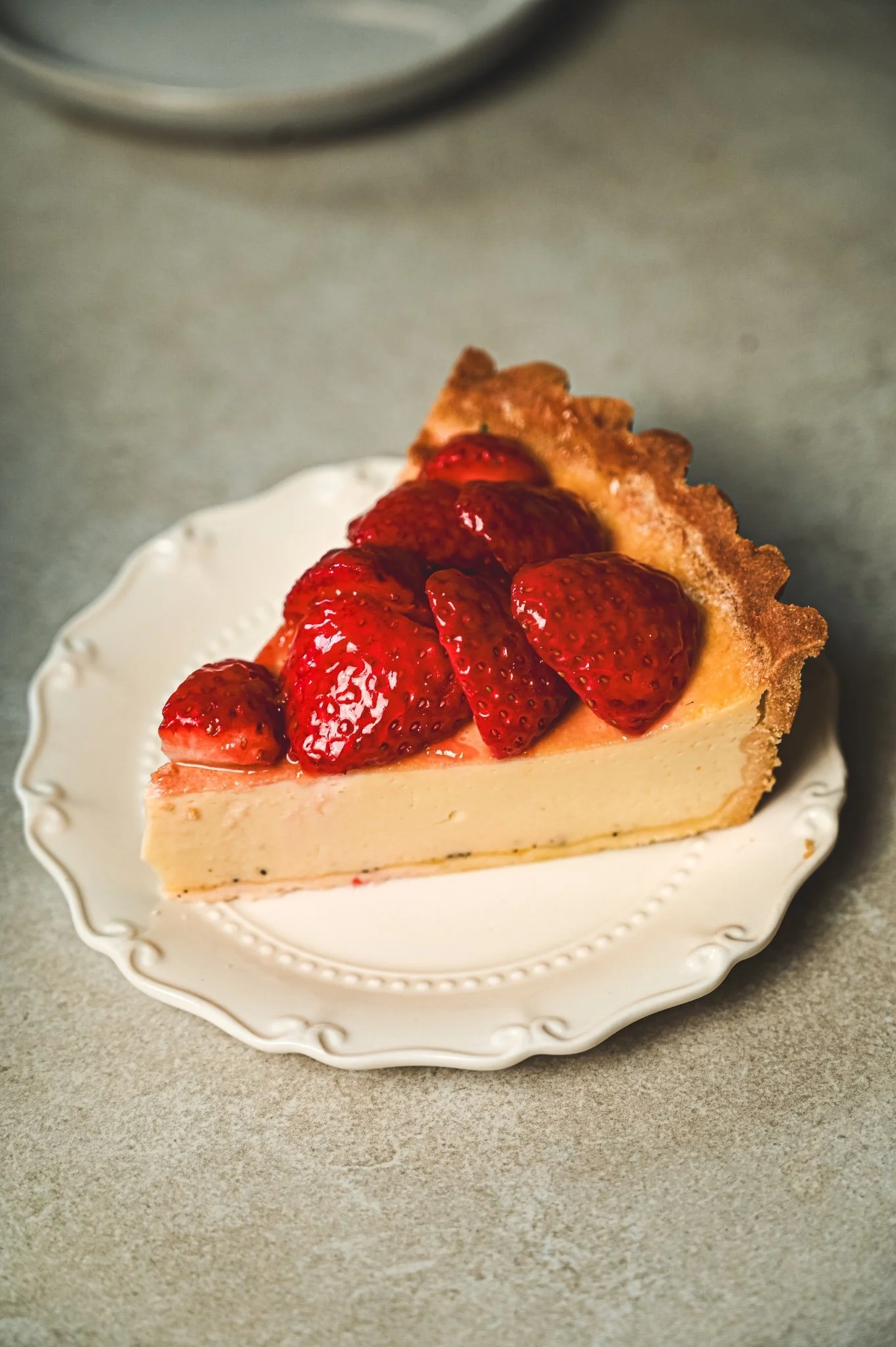
This strawberry custard tart sets a gentle black pepper custard under glazed strawberries in a crisp pâte sucrée shell. It is built like a French flan pâtissier: the custard is cooked briefly on the stove, then set in a low oven so it slices cleanly, the top taking just a little colour. The pepper sits quietly underneath, warm rather than spicy, against the sweet fruit. Make the tart a day ahead and top it on the day.

Black Pepper Custard Tart with Glazed Strawberries
A pâte sucrée shell filled with a gently spiced black pepper custard, set like a French flan pâtissier and topped with glazed strawberries. Make it a day ahead and top on the day.
Ingredients
- 250g plain flour
- 125g cold unsalted butter, cut into 1cm cubes
- 60g icing sugar
- 1 large egg yolk
- 1 to 2 tablespoons ice-cold water
- A pinch of fine salt
- 700ml whole milk
- 300ml double cream
- 2 teaspoons black pepper, coarsely cracked (not ground)
- 4 large eggs, at room temperature
- 5 large egg yolks, at room temperature
- 120g caster sugar
- 60g plain flour
- A pinch of fine salt
- 600g strawberries, hulled and sliced lengthways 4 to 5mm thick
- 100g apricot jam, or redcurrant jelly
- 1 tablespoon water
Instructions
- Combine the flour, icing sugar and salt in a large bowl. Add the cold butter and rub in with your fingertips (or in a blender) until the mixture resembles coarse breadcrumbs with no visible lumps of butter.
- Add the egg yolk and 1 tablespoon of ice-cold water and bring together quickly with your hands until the dough just coheres. Add a second tablespoon of water only if it is visibly dry and crumbling; it should not be sticky. Flatten into a disc, wrap and refrigerate for at least 1 hour, or overnight.
- Grease and line a 24cm fluted tart tin with a circle of parchment on the base.
- On a lightly floured surface, roll the pastry to 3 to 4mm thick in a circle wide enough to line the tin and its 5cm sides, roughly 36 to 38cm across. Roll it loosely around the pin to lift it, then unroll over the tin.
- Ease the pastry into the corners and up the fluted sides without stretching it, as stretched pastry shrinks. Tear a small amount of the overhanging pastry off, roll to into a ball and dip it lightly in plain flour. Use this to press gently into every flute. Trim the overhang by rolling the pin across the top edge or by pressing outwards with your thumb. Prick all over the base with a fork to prevent shrinkage. Refrigerate the lined tin for at least 30 minutes.
- Preheat the oven to 160°C fan (180°C conventional). Line the chilled case with scrunched baking paper and fill completely to the top with baking weights or dried beans. For a 5cm deep tin, filling to the top is essential, or the sides collapse inward.
- Bake for 15 minutes, then lift out the paper and weights. Return the case to the oven for a further 10 minutes, until the base is a confident golden colour.
- Whisk the remaining whole egg and brush a thin layer over the base and sides of the hot case, then return it to the oven for 5 minutes. This seals the fork holes and any hairline cracks so the custard cannot seep out, and keeps the base crisp. Cool to room temperature before filling.
- Toast the peppercorns in a dry pan over medium heat for 1 to 2 minutes, until fragrant, shaking the pan so they do not catch. Tip them out into a pestle and mortar, let them cool for a moment, then crush coarsely.
- Pour the milk and cream into a medium heavy-based pan and add the cracked black pepper. Heat to steaming, around 70°C, just before simmering. Remove from the heat, cover and steep for 20 minutes. The pepper infuses into the fat best at this temperature; boiling drives off the aromatics.
- In a large bowl, whisk the whole eggs, yolks and sugar together. Once the sugar has dissolved, add the flour and salt and whisk until smooth, with no lumps of flour. Use a balloon whisk and be thorough, as any lumps survive into the finished custard.
- Whisking constantly, slowly pour a the hot infused milk through a sieve onto the eggs to temper them. Clean the pan and then pour the tempered mixture back into it.
- Return to medium-low heat and cook, stirring continuously with a spatula and reaching the base and corners, for a minute or two until it just begins to slightly thicken and bubble. It stays pourable at this stage and does not set in the pan: the brief cook hydrates the flour so it will not taste raw or sink, and also tempers the eggs. The oven does the setting. Remove from the heat.
- Strain the hot custard through a fine sieve into a bowl or large jug, which catches any potential lumps. Then ladle or pour it gently into the cooled, room-temperature case, filling to about half a centimetre below the rim. That headspace matters; filled to the brim it would spill as you moved it.
- Reduce the oven to 150°C fan (170°C conventional) and bake for 35 to 40 minutes. The top will take on a little colour. It is ready when the edges are set and the centre holds a slow, uniform wobble when the tin is moved gently, like set jelly rather than a liquid slosh; it firms further as it cools and chills. Do not overbake.
- Cool in the tin at room temperature for at least 1 hour. Do not move it straight to the fridge, as a sudden temperature change can crack the surface. Then refrigerate uncovered for at least 4 hours, ideally overnight, until fully cold and set.
- To unmould push the base up slowly and evenly. Remove the ring, slide a thin palette knife between base and pastry to release and remove the paper and transfer to a flat plate, cake stand or board.
- Arrange the sliced strawberries over the set custard in overlapping concentric circles, working from the inside outwards.
- Warm the apricot jam, with the water in a small pan over low heat, stirring until smooth and fluid. Brush generously and evenly over all the strawberries while warm. It sets within 5 to 10 minutes to a semi-firm gloss. Apricot gives a golden, neutral sheen; redcurrant jelly is the alternative for a more vivid red.
Nutrition Facts
Calories
470Fat
26 gSugar
27 gProtein
9 gCarbs
47 gApproximate values per serving


Ingredient Notes
Pastry
A pâte sucrée, richer and sweeter than shortcrust, which bakes to a firm, snappy shell that holds a deep custard without going soft. Keep the butter cold and handle the dough as little as you can. Chilling the lined case and pricking with a fork before baking is what stops it shrinking.
Black pepper
Crack it coarsely in a pstle and mortar rather than grinding it fine, so it infuses the cream cleanly and strains out without leaving grit. Steeped into the warm cream rather than cooked hard, it gives a soft, rounded warmth, not heat.
Eggs
A mix of whole eggs and extra yolks. The yolks enrich the custard and help it set to a clean slice, while the whites give it enough structure to hold its shape.
Strawberries
Choose firm, evenly sized berries. They sit on top in full view, so equal sizes give the cleanest finish. Ripe but not soft, or they weep under the glaze.
Apricot jam
Warmed and strained for a smooth, golden, neutral sheen that lets the strawberries show. Redcurrant jelly is the alternative for a more vivid red.
Kitchen Notes
The blind bake
The most important step. The base must be a confident golden colour and completely dry before the custard goes in, or it turns soggy under the filling and will not slice cleanly. For a deep tin, fill the weights right to the top, or the sides can slump inward.
The stove cook
The custard is cooked briefly on the stove before it goes into the case, but it is not meant to thicken or set there, and it won't. There is too little flour for that. The brief cook does two quieter jobs: it tempers the eggs, warming them gently so they set smoothly in the oven rather than curdling, and it hydrates the flour so it disperses evenly and does not taste raw or sink to the base. The custard goes in still pourable, and the oven and the overnight chill do the setting.
Room temperature eggs
Take them out at least half an hour ahead. Cold eggs in hot milk drop the temperature and risk setting unevenly on the stove.
Knowing when it is baked
It is ready when the edges are set and the centre holds a gentle, even wobble when you move the tin, like set jelly rather than a liquid slosh. It firms further as it cools and chills, so do not chase a firm centre in the oven or you will over bake it.
If your tin is shallower
This is a deep 5cm tart, which is slightly more unusual; many tart tins are only around 3cm. You can use a 3cm tin of a similar width, though I would not choose to: the slice is smaller and you lose the deep cross section of custard, which is half the appeal. If it is the tin you have, keep the pastry, strawberries and glaze as they are, since the width and surface are much the same. You will only need about two-thirds of the custard. 470ml whole milk, 200ml double cream, 1.5 teaspoons black peppercorns (toasted and coarsely crushed), 2 whole eggs plus 4 yolks, 80g caster sugar, 40g plain flour, and the pinch of salt as before. Drop the custard bake to around 25 to 30 minutes and start checking for the wobble early, as a shallower custard sets faster.
Cooling and chilling
Cool in the tin at room temperature for at least an hour before it goes near the fridge, as a sudden change can crack the surface. Then chill uncovered for at least four hours, ideally overnight. It must be fully cold and set before you top it.
Make ahead and slicing
The tart keeps for up to two days in the fridge. Top with strawberries and glaze on the day, as glazed fruit weeps after three or four hours. For clean slices, use a long sharp knife dipped in hot water and wiped dry between each cut.
Variations
A classic flan pâtissier
Leave off the strawberries and glaze, infuse the cream with a vanilla pod in place of the pepper, and bake a little higher so the top browns properly. That is the classic the tart is built on.
Why pepper with strawberries
Black pepper and strawberry is an old pairing, like strawberries with balsamic. The pepper does not make the tart taste peppery. It lifts the fruit, adds a gentle warmth behind the sweetness and keeps a rich custard from tasting one-note. If it does not appeal, leave it out and infuse the cream with a split vanilla pod or a few strips of lemon zest instead, for a plainer custard that works just as well under the strawberries.
Other fruit
Raspberries, halved cherries or a mix of summer berries all work in place of the strawberries, glazed the same way.
Serving Suggestions
How to serve
Cold or at cool room temperature, sliced with a hot, dry knife for clean edges. It is rich, but not overly sweet so the slices can be generous.
What to serve alongside
It really doesn't need anything in addition but if you want something, a spoonful of crème fraiche or softly whipped cream offsets the richness.
Drinks
A glass of chilled dessert wine with enough acidity suits it, a Sauternes or a late-harvest Riesling. For something lighter, strong black coffee or black tea works against the richness.
Zero Waste
Use the five spare egg whites
The custard takes five yolks beyond the four whole eggs, which leaves you five whites. They keep a few days in the fridge or freeze well in a labelled sandwich bag, and there is plenty to do with them: meringues, financiers, friands, macarons, or an egg-white omelette.
Pastry offcuts
The trimmed pastry re-rolls into a few jam tarts, or freezes to add to a future case.
FAQ
Why is my custard tart base soggy? An underbaked shell. Blind bake until the base is genuinely golden and dry all the way through, and for a deep tin keep the weights filled to the top.
Can you make a custard tart ahead? Yes, up to two days. Top with strawberries and glaze on the day though, as glazed fruit starts to weep after three to four hours.
Why did my custard tart crack? Usually over baking, or moving it from a warm oven straight into the fridge. Cool it at room temperature first, then chill.
Why brush egg over the tart base? It seals the fork holes and any hairline cracks in the blind-baked pastry, so the wet custard cannot seep underneath and soften the base. A quick five minutes back in the oven sets that seal and keeps the base crisp.
What does black pepper do in a custard tart? Steeped into the warm cream, it adds a soft, rounded warmth rather than heat, which lifts the sweetness without reading as spicy.
Which glaze should I use? Apricot jam, strained, gives a golden, neutral sheen, which is what I use here. Redcurrant jelly is the alternative for a more vivid red that plays up the strawberry colour.
Is this a flan pâtissier? Effectively yes. The custard is cooked briefly on the stove then set in the oven, the flan pâtissier method, with fresh strawberries and a glaze on top borrowed from a tarte aux fraises.